
10 Metrics Every CIO Wants Before Approving Test Automation Investment


Build a Strong Business Case with Data-Driven Quality Engineering Insights
Introduction
Test automation has become an essential capability for organisations seeking to deliver high-quality software at speed. Modern software delivery relies on frequent releases, continuous integration, and rapid feedback, making automation an important part of Quality Engineering.
Despite its technical advantages, securing executive approval for automation initiatives is not always straightforward.
Engineering teams often understand the operational benefits of automation—faster regression testing, improved software quality, reduced repetitive effort, and greater release confidence. However, senior executives evaluate investments differently.
A Chief Information Officer (CIO) is responsible for balancing technology investments against organisational priorities. Every proposal competes for limited budgets, skilled resources, and executive attention. Before approving funding, CIOs need confidence that an automation initiative will deliver measurable business value rather than simply introducing another technology project.
Questions such as:
What problem does automation solve?
How much will it cost?
What return can we expect?
How quickly will the investment pay for itself?
What risks will it reduce?
How will success be measured?
are commonly asked during investment discussions.
The organisations that secure automation funding are rarely those with the most technically advanced frameworks. Instead, they are the organisations that present automation as a business investment supported by meaningful metrics and objective evidence.
This article explores ten of the most important metrics CIOs evaluate before approving test automation investment and explains how these metrics help build a stronger business case.
Why CIOs Evaluate Technology Investments Differently
Software engineers often view automation through a technical lens.
Executives view automation through a business lens.
A CIO is responsible for ensuring technology investments contribute to organisational objectives while balancing competing priorities such as:
Digital transformation
Cybersecurity
Cloud migration
Infrastructure modernisation
Artificial Intelligence
Regulatory compliance
Customer experience
Operational efficiency
Every investment must demonstrate value. Choosing Playwright over Selenium, or one reporting solution over another, is rarely the deciding factor.
Instead, CIOs ask:
Will this investment improve business outcomes?
That shift in perspective changes the entire conversation.
Instead of discussing frameworks and programming languages, successful automation proposals focus on measurable improvements in productivity, software quality, delivery confidence, operational efficiency, and financial return.
What Makes a Strong Automation Business Case?
Many automation proposals fail because they focus exclusively on technology.
For example:
❌ "We should move to Playwright."
While technically valid, this statement does not explain why the organisation should invest.
A stronger proposal might say:
✅ "Implementing automation is expected to reduce regression testing effort, improve release confidence, support faster software delivery, and reduce long-term testing costs."
Notice the difference.
The second statement focuses on business outcomes rather than implementation details.
A successful automation business case should demonstrate:
Financial value
Operational improvements
Engineering productivity
Software quality improvements
Risk reduction
Long-term sustainability
Supporting these claims with measurable metrics significantly improves executive confidence.
1. Total Investment Cost
The first question most CIOs ask is simple:
How much will this cost?
A realistic estimate should include all costs associated with implementation rather than only software licensing.
Typical investment areas include:
Framework development
Automation engineering effort
Infrastructure
Cloud execution
Training
CI/CD integration
Ongoing maintenance
Presenting a complete investment estimate demonstrates transparency and realistic planning.
Avoid underestimating costs simply to make automation appear attractive.
Decision-makers value accurate planning far more than optimistic projections.
2. Return on Investment (ROI)
ROI remains one of the most recognised financial metrics used to evaluate technology investments.
A commonly used formula is:
ROI (%) = (Total Benefits − Total Costs) ÷ Total Costs × 100
Benefits may include:
Reduced manual testing effort
Faster regression execution
Improved engineering productivity
Reduced production defects
Faster software delivery
Costs typically include:
Development
Infrastructure
Maintenance
Training
Engineering effort
Rather than relying on assumptions, organisations should calculate ROI using project-specific inputs whenever possible.
Objective calculations build greater confidence than generic estimates.

3. Payback Period
Return on investment tells executives whether automation creates value.
Payback period answers another important question:
How quickly will we recover our investment?
Shorter payback periods reduce financial risk and improve investment confidence.
For example, if automation requires an initial investment of NZ$50,000 but generates annual savings of NZ$30,000, decision-makers can estimate when the investment begins delivering positive financial returns.
Payback period is particularly useful when comparing multiple technology initiatives competing for the same budget.
4. Annual Cost Savings
Automation is frequently justified through cost reduction.
Examples include:
Reduced regression testing effort
Lower manual execution costs
Reduced overtime
Faster release preparation
Improved resource utilisation
Annual savings provide executives with a straightforward financial measure of automation's long-term value.
These savings often increase over time as additional automated tests are introduced and release frequency grows.
5. Current Manual Testing Effort
Automation ROI cannot be measured without understanding the current baseline.
Useful baseline metrics include:
Regression duration
Manual execution hours
Number of testers
Release frequency
Total manual effort
Understanding today's testing effort allows organisations to estimate future improvements more accurately.
Without baseline data, projected savings become difficult to justify.
6. Automation Coverage
Not every test should be automated.
Executives often ask:
What percentage of testing is suitable for automation?
Which scenarios provide the greatest value?
Where should investment begin?
Automation coverage helps answer these questions.
High-value automation candidates often include:
Regression testing
Repetitive scenarios
Stable business functionality
High-volume testing
By prioritising suitable scenarios, organisations maximise both ROI and engineering productivity.
7. Engineering Productivity
One of automation's greatest benefits extends beyond financial savings.
Automation enables engineers to spend less time executing repetitive regression tests and more time performing higher-value activities.
Examples include:
Exploratory testing
Risk analysis
Test design
Business validation
Performance improvements
Collaboration with delivery teams
Higher engineering productivity contributes to improved software quality while helping teams deliver more value without proportionally increasing resources.
Although productivity improvements can be difficult to express financially, they represent a significant strategic benefit.
8. Release Frequency
Automation becomes increasingly valuable as release frequency increases.
Consider two organisations:
Organisation A releases software twice each year.
Organisation B releases every two weeks.
The second organisation executes regression testing significantly more often, making automation considerably more valuable.
Higher release frequency increases opportunities to:
Reduce regression effort
Improve release confidence
Deliver software faster
Detect defects earlier
Release frequency should therefore be included in every automation business case.
9. Software Quality and Risk Reduction
Executives are not investing solely to reduce testing effort.
They are investing to reduce organisational risk.
Automation contributes to:
Earlier defect detection
Reduced production incidents
Improved customer satisfaction
Increased release confidence
Better compliance
Greater software reliability
These benefits may not always be expressed directly as financial savings, but they contribute significantly to long-term business performance.
Reducing a single production incident can often justify a substantial portion of an automation investment. Quality should therefore be presented as both an engineering objective and a business outcome.
10. Executive Summary
Technical reports often contain detailed calculations, assumptions, and implementation plans.
Executives usually need something different.
A concise executive summary should communicate:
Total investment
Expected ROI
Payback period
Annual savings
Key assumptions
Business benefits
Investment recommendation
An effective executive summary enables decision-makers to review the proposal quickly while maintaining confidence in the supporting analysis.
Clear visual reporting improves communication and accelerates decision-making.
Example Business Case
Imagine a financial services organisation that executes a regression suite every two weeks.
Current situation:
450 regression test cases
Four manual testers
Twenty-six regression cycles annually
Manual regression requires approximately 30 working days per cycle
The engineering team proposes automating approximately 70% of suitable regression scenarios.
Using project-specific assumptions, the estimated business outcomes include:
Significant reduction in manual regression effort
Faster execution cycles
Improved release confidence
Reduced long-term testing costs
Positive ROI
Attractive payback period
Rather than presenting multiple spreadsheets to management, the engineering team prepares a dashboard summarising:
Investment cost
Annual savings
ROI
Payback period
Automation suitability
Executive recommendation
This enables senior stakeholders to understand the proposal within minutes rather than reviewing pages of calculations.
Common Mistakes When Presenting Automation Investment
Many automation proposals fail because they:
Focus only on technology
Ignore long-term maintenance
Overestimate savings
Underestimate implementation effort
Present unrealistic assumptions
Lack measurable outcomes
Provide no executive summary
A successful proposal balances technical accuracy with business relevance.
Executives are rarely interested in programming languages or framework architecture unless those choices clearly support business objectives.
How OQVERIN Helps
Building a business case manually often requires multiple spreadsheets, assumptions, calculations, and significant preparation.
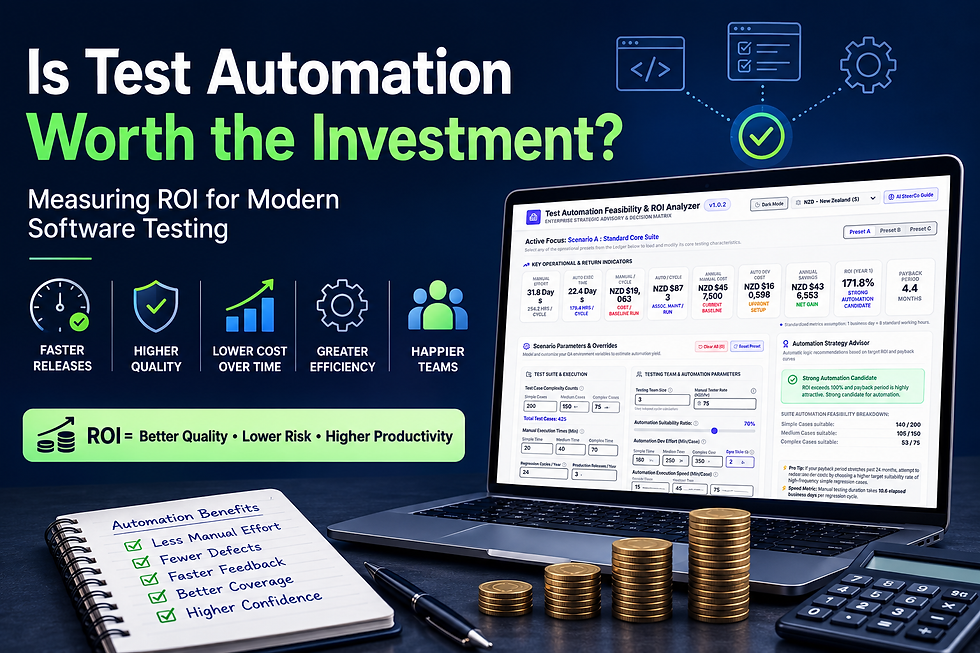
The OQVERIN ROI Analyzer helps Quality Engineering teams evaluate automation investment using project-specific inputs.
The application provides executive-friendly insights including:
Total investment cost
Return on Investment (ROI)
Payback period
Annual savings
Cost comparisons
Automation suitability
Interactive charts
Executive summaries
Investment recommendations
These insights help engineering teams communicate automation value more effectively while supporting informed investment decisions.
Rather than relying on generic estimates, organisations can present structured, data-driven analysis that aligns with executive expectations.


Final Thoughts
Approving test automation is ultimately a business decision rather than a technical one. While frameworks, tools, and engineering practices remain important, executives require evidence that automation will create measurable value for the organisation.
By presenting clear financial metrics, realistic assumptions, quality improvements, and executive-friendly reporting, engineering teams can significantly strengthen their automation business case.
Successful automation proposals demonstrate not only how technology works, but also why it matters to the business.
Organisations that combine strong Quality Engineering practices with objective ROI analysis are better positioned to make informed investment decisions, improve software quality, and maximise the long-term value of automation.
Key Takeaways
CIOs evaluate business value before approving automation investment.
ROI is important but should be supported by additional metrics.
Include investment cost, annual savings, payback period, productivity, and risk reduction.
Use visual dashboards and executive summaries to communicate value clearly.
Support proposals with realistic, project-specific assumptions.
Present automation as a business investment rather than a technical initiative.
Data-driven Quality Engineering insights improve executive confidence and decision-making.
Suggested Internal Links
Try OQVERIN ROI Analyzer: 7-day free trial

Comments