
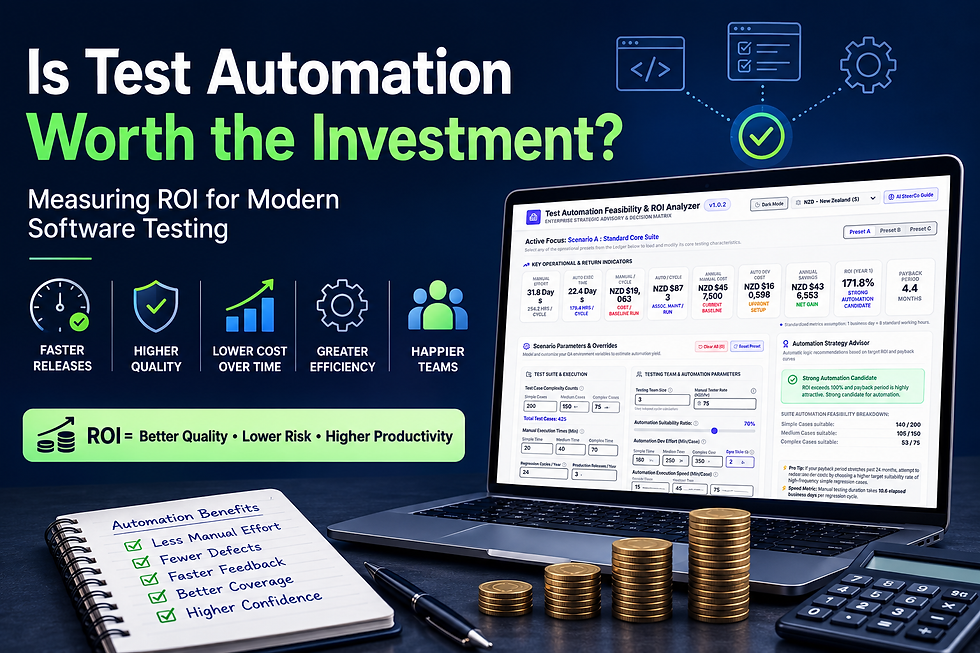
Is Test Automation Worth the Investment? Measuring ROI for Modern Software Testing

Introduction
Software delivery has never moved faster. Organisations are expected to release new features more frequently, respond quickly to customer feedback, and maintain exceptional software quality—all while operating within constrained budgets and delivery timelines.
To meet these expectations, many organisations invest heavily in test automation. Modern automation frameworks can execute thousands of tests in a fraction of the time required for manual testing, enabling continuous integration, faster feedback, and improved release confidence.
Despite these benefits, one question continues to arise in boardrooms, project reviews, and budget discussions:
Is test automation worth the investment?
The answer depends on how organisations measure value.
Many teams focus only on the initial costs of automation—tools, framework development, infrastructure, and engineering effort—without considering the long-term operational, financial, and quality benefits. Others expect immediate returns, overlooking the fact that automation is a strategic investment that delivers increasing value over time.
Understanding Return on Investment (ROI) allows organisations to make informed decisions about where automation creates the greatest value and how to maximise that investment.
In this article, we'll explore what test automation ROI really means, the costs and benefits involved, common mistakes organisations make, and how modern technologies such as Artificial Intelligence are changing the economics of software testing.
Understanding Test Automation ROI
Return on Investment (ROI) measures the value gained compared to the cost of an investment.
In software testing, ROI is not simply about reducing testing costs. It also includes improvements in quality, productivity, release confidence, and business outcomes.
A simplified ROI formula is:
ROI = (Benefits − Costs) ÷ Costs × 100
While the formula appears straightforward, accurately measuring both costs and benefits requires a broader view than simply comparing manual testing hours with automation execution time.
Successful organisations evaluate automation as a long-term engineering capability rather than a short-term cost-saving initiative.
The Real Costs of Test Automation
Automation is not free.
Organisations should understand the complete investment before evaluating returns.
Framework Development
Every automation initiative begins with establishing a framework.
This often includes:
Framework architecture
Project structure
Configuration management
Reporting
Logging
Test data management
CI/CD integration
Documentation
Developing this foundation requires skilled engineering effort before any business scenarios are automated.
Automation Engineering
Automation engineers design:
Test cases
Page Objects
Reusable components
API clients
Helper libraries
Validation logic
Their expertise represents one of the largest ongoing investments.
Infrastructure
Automation execution often requires:
Build agents
Cloud infrastructure
Docker containers
Virtual machines
Browser execution environments
Test environments
These operational costs should be included in ROI calculations.
Tooling
Although many automation tools are open source, organisations still invest in:
Test management platforms
CI/CD platforms
Reporting tools
Monitoring solutions
Cloud execution services
Maintenance
Automation is not a one-time activity.
Applications evolve continuously.
Automation frameworks require:
Updating locators
Maintaining Page Objects
Reviewing flaky tests
Updating dependencies
Improving architecture
Maintenance is an ongoing operational investment.
The Benefits of Test Automation
While costs are visible immediately, benefits accumulate over time.
Faster Regression Testing
Automation dramatically reduces regression testing effort.
Instead of spending several days executing manual regression tests, automated suites can complete within hours—or even minutes.
This allows organisations to release software more frequently.
Faster Feedback
Automated testing provides rapid feedback after every code change.
Developers identify issues earlier, reducing the cost of fixing defects.
Improved Software Quality
Automation increases consistency.
Unlike manual execution, automated tests perform the same validation every time, reducing human error.
Increased Release Confidence
Reliable automation provides greater confidence before production deployments.
This supports:
Faster releases
Lower production risk
Better customer experience
Better Resource Utilisation
Automation allows experienced testers to focus on activities that require critical thinking, including:
Exploratory testing
Risk analysis
Usability evaluation
Business validation
Rather than repeatedly executing identical regression tests.
Improved Productivity
Once established, automation enables teams to execute larger test suites with significantly less manual effort.
This productivity gain compounds over multiple releases.
Hidden Benefits That Organisations Often Miss
Many ROI discussions focus only on testing effort.
However, automation delivers broader organisational value.
Examples include:
Earlier defect detection
Improved collaboration
Faster onboarding
Consistent engineering standards
Better compliance
Reduced business risk
Improved customer satisfaction
Faster incident investigation
These benefits are difficult to express in dollars but contribute significantly to overall ROI.
Hidden Costs That Reduce ROI
Automation can also fail to deliver expected returns.
Common causes include:
Poor Framework Architecture
Weak architecture increases maintenance effort.
Flaky Tests
Unstable automation reduces confidence.
Teams begin ignoring failures.
Technical Debt
Poor coding practices increase long-term maintenance costs.
Lack of Standards
Different teams create different frameworks.
Knowledge sharing becomes difficult.
Automating Everything
Not every test should be automated.
Attempting to automate unstable or low-value scenarios often reduces ROI.
Manual Testing vs Test Automation
Manual Testing | Test Automation |
Repetitive execution | Automated execution |
Slower regression | Faster regression |
Human error | Consistent execution |
Higher long-term effort | Higher initial investment, lower ongoing effort |
Difficult to scale | Highly scalable |
Limited release frequency | Supports continuous delivery |
Automation complements manual testing rather than replacing it.
Both remain essential.
Measuring Test Automation ROI
Effective ROI measurement considers multiple factors.
Costs
Framework development
Engineering effort
Infrastructure
Maintenance
Training
Tooling
Benefits
Time saved
Faster releases
Reduced production defects
Lower manual effort
Increased productivity
Improved software quality
A balanced evaluation considers both quantitative and qualitative outcomes.
Example ROI Calculation
Imagine an organisation that performs:
Regression testing every two weeks
Manual regression requires 40 hours
Automation reduces execution to 4 hours
Over one year:
Manual effort:
40 × 26 = 1,040 hours
Automated effort:
4 × 26 = 104 hours
Time saved = 936 hours annually
This does not include:
Earlier defect detection
Faster releases
Improved customer satisfaction
Reduced production incidents
These additional benefits further improve ROI.
How Artificial Intelligence Is Changing Test Automation ROI
Artificial Intelligence is transforming software engineering by reducing repetitive engineering work.
Rather than replacing automation engineers, AI accelerates tasks
such as:
Framework generation
Project scaffolding
Configuration
Documentation
Code suggestions
Standardised project structures
Reducing setup effort allows teams to begin automating business functionality sooner.
As a result:
Framework development time decreases
Engineering productivity increases
Standardisation improves
Time-to-value becomes shorter
AI changes not only how automation is built but also how quickly organisations begin realising return on investment.
Common ROI Mistakes
Organisations often reduce ROI by:
Measuring only execution time
Ignoring maintenance costs
Automating unstable functionality
Building overly complex frameworks
Failing to define automation goals
Treating automation as a short-term project
Automation should be viewed as a long-term engineering capability.
How OQVERIN Helps
Understanding automation ROI can be challenging because every organisation has different delivery processes, release frequencies, team structures, and testing practices.
The OQVERIN ROI Analyzer helps Quality Engineering leaders estimate the potential business value of automation initiatives using project-specific metrics.
In addition, the OQVERIN AI Framework Generator helps reduce framework setup effort by generating structured automation frameworks, allowing engineering teams to spend more time building automated tests and less time creating project infrastructure.
Together, these capabilities help organisations make more informed automation decisions while accelerating the journey toward scalable Quality Engineering.
Final Thoughts
Test automation should not be viewed as a cost—it should be viewed as a strategic investment in software quality.
Although automation requires upfront effort, organisations that invest in scalable frameworks, engineering best practices, and continuous improvement often realise significant long-term benefits through faster releases, improved quality, reduced manual effort, and greater delivery confidence.
As Artificial Intelligence continues to evolve, organisations have new opportunities to reduce repetitive engineering work, improve standardisation, and accelerate the return on their automation investments.
The question is no longer whether organisations should invest in automation.
The more important question is:
How can organisations maximise the value of that investment?
Key Takeaways
Test automation is a long-term investment, not simply a cost.
ROI includes quality, productivity, and business outcomes—not just execution time.
Scalable frameworks improve long-term maintainability.
Poor architecture and unstable automation reduce ROI.
AI can reduce framework setup effort and accelerate time-to-value.
Measuring ROI helps organisations make better automation decisions.
Suggested Internal Links
AI Playwright Framework Generator: Build Enterprise Test Automation Frameworks in Minutes
How to Build a Scalable Test Automation Framework
What Is AI Quality Engineering? (future article)
Test Automation ROI Analyzer (product page)


Comments