
Test Automation ROI Calculator: How to Calculate ROI in 2026


Introduction
In today's competitive software delivery landscape, organizations are under constant pressure to release high-quality software faster while controlling costs. Agile development, DevOps, continuous integration, and continuous delivery (CI/CD) have significantly accelerated software delivery cycles. However, one challenge remains consistent across industries:
How do you justify investing in test automation?
While engineering teams often recognize the technical benefits of automation, senior executives and finance stakeholders typically require a strong business case before approving investments. Questions such as the following are common during budget discussions:
What is the expected return on investment (ROI)?
How much manual testing effort can be reduced?
How long will it take to recover the initial investment?
Will automation actually lower long-term costs?
Which projects should be automated first?
Unfortunately, many organizations still rely on complex spreadsheets, assumptions, and manual calculations to answer these questions. Preparing an automation business case often takes several hours—or even days—and the results can vary significantly depending on the assumptions made.
This is where a Test Automation ROI Calculator becomes invaluable.
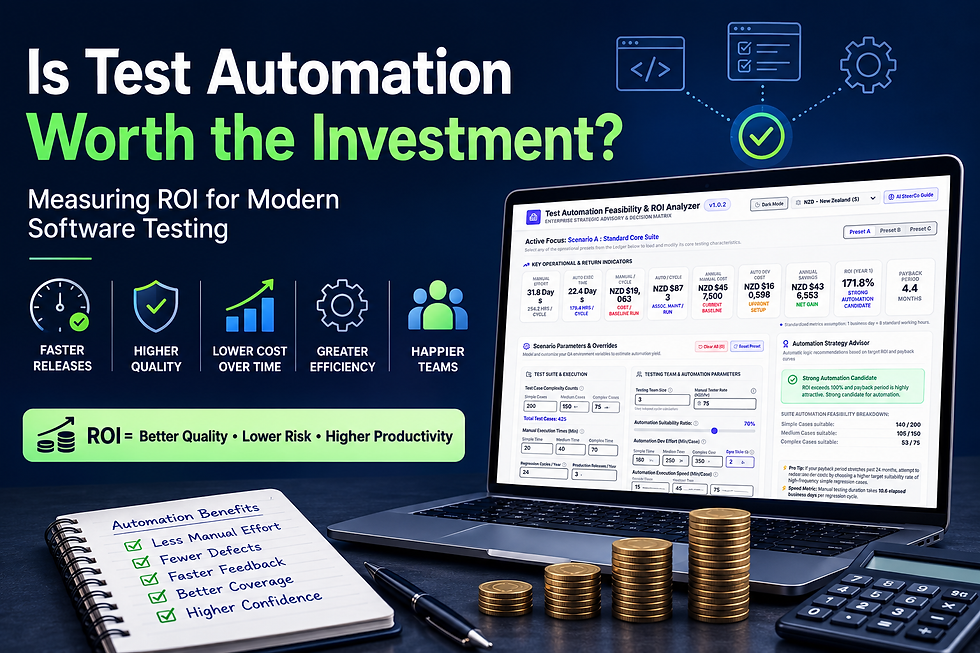
A well-designed ROI calculator helps technology leaders evaluate the financial impact of automation by estimating implementation costs, ongoing maintenance expenses, projected savings, payback period, and overall return on investment. Instead of relying on guesswork, organizations can make evidence-based decisions supported by data.
In this comprehensive guide, you'll learn:
What Test Automation ROI is
How ROI is calculated
The complete ROI formula
Costs commonly overlooked
Benefits beyond labour savings
Common mistakes organizations make
Real-world ROI calculation example
How AI is transforming automation investment analysis
Whether you're a CIO, CTO, Test Manager, Quality Engineering Lead, or Delivery Manager, this guide will help you build a stronger business case for automation initiatives.
What Is Test Automation ROI?
Return on Investment (ROI) is one of the most important financial metrics used to evaluate whether an investment delivers sufficient value compared to its cost.
For software testing, ROI measures whether investing in automation generates greater business benefits than continuing with manual testing.
In simple terms:
Does the money invested in automation produce measurable savings and business value over time?
A positive ROI indicates that automation is generating more value than it costs.
A negative ROI suggests the investment has not yet recovered its implementation and maintenance costs.
Unlike traditional manual testing, automation requires an upfront investment before benefits are realized. This investment typically includes:
Framework development
Test script development
Infrastructure
CI/CD integration
Training
Maintenance
Although these costs can appear significant initially, the investment is usually recovered through repeated execution of automated regression suites across multiple releases.
Why ROI Matters to Business Leaders
Engineering teams often focus on technical improvements, such as:
Better code quality
Faster regression execution
Increased automation coverage
Improved consistency
While these are important, executives generally evaluate automation from a different perspective.
They ask questions such as:
Will this reduce operational costs?
Can we release software more frequently?
What financial benefit will this deliver?
What risks are reduced?
When will we recover the investment?
Automation projects are therefore business investments—not simply technology initiatives.
A well-prepared ROI analysis allows decision-makers to compare automation initiatives against other competing investments, helping ensure budgets are allocated where they will generate the greatest value.
Why Many ROI Calculations Fail
One of the biggest reasons automation business cases fail is that organizations underestimate both costs and benefits.
Many ROI calculations only compare:
Manual testing effort versus automation effort.
However, this simplistic approach ignores several important factors.
For example:
Hidden Costs
Many organizations overlook costs such as:
Framework architecture
Test environment management
Continuous maintenance
CI/CD implementation
Infrastructure
Training new team members
Test data management
Reporting
Cloud execution
Ignoring these costs often results in unrealistic ROI expectations.
Hidden Benefits
Similarly, many organizations underestimate automation benefits beyond labour savings.
Automation also delivers value by:
Detecting defects earlier
Reducing production incidents
Increasing release confidence
Supporting continuous delivery
Improving developer productivity
Increasing test coverage
Reducing repetitive manual work
Improving employee satisfaction
These benefits can significantly influence long-term ROI.
Why Spreadsheets Are No Longer Enough
Traditionally, organizations have relied on Excel spreadsheets to estimate automation ROI.
Although spreadsheets are flexible, they introduce several challenges:
Manual calculations
Users must manually enter assumptions, formulas, costs, and effort estimates.
Inconsistent assumptions
Different teams often calculate ROI differently, making comparisons difficult.
Limited executive reporting
Spreadsheets rarely provide executive-ready summaries suitable for CIOs or investment committees.
Difficult scenario analysis
Evaluating multiple automation scenarios often requires creating several spreadsheet versions.
Time-consuming updates
Every change to project scope or resource costs requires manual recalculation.
For large enterprise programmes involving multiple teams and applications, maintaining ROI spreadsheets quickly becomes both time-consuming and error-prone.
Modern organizations increasingly use AI-assisted analysis to automate these calculations, generate executive summaries, visualize financial impacts, and compare investment scenarios within minutes.
Why an Accurate ROI Calculation Matters
An accurate ROI calculation provides far more than a financial number.
It enables organizations to:
Prioritize automation investments.
Compare multiple automation opportunities.
Secure executive approval.
Improve budgeting accuracy.
Reduce investment risk.
Forecast long-term savings.
Support digital transformation initiatives.
Demonstrate measurable business value.
Rather than viewing automation as a technical expense, organizations begin treating it as a strategic investment that supports faster delivery, higher quality, and better customer outcomes.
Test Automation ROI Formula, Cost Components and Business Benefits
The Test Automation ROI Formula
Before investing in automation, organisations need a reliable method to evaluate whether the investment will generate measurable business value. The most widely accepted approach is the Return on Investment (ROI) calculation.
The standard formula is:
ROI (%) = ((Total Benefits − Total Costs) ÷ Total Costs) × 100
Where:
Total Benefits = Financial value gained from automation.
Total Costs = Total investment required to implement and maintain automation.
A positive ROI indicates that the benefits exceed the costs, while a negative ROI suggests that the investment has not yet paid for itself.
For example:
Total Benefits | Total Costs | ROI |
$350,000 | $100,000 | 250% |
$180,000 | $120,000 | 50% |
$90,000 | $120,000 | -25% |
Although the formula itself is straightforward, accurately estimating both costs and benefits is where many organisations struggle.
Understanding Automation Costs
One of the most common mistakes organisations make is underestimating the true cost of automation.
Automation is far more than writing test scripts. It involves designing, building, maintaining and continuously improving an engineering capability.
Below are the major cost components that should be included in every ROI calculation.
1. Framework Development
Every automation initiative requires an initial framework.
Typical activities include:
Framework architecture
Project structure
Configuration
Reporting
Logging
Utilities
Page Object Model implementation
Reusable components
Although this is generally a one-time investment, it forms a significant portion of the initial cost.
2. Test Script Development
Writing automated tests requires skilled engineers.
Development effort varies depending on:
Application complexity
Business processes
Number of test scenarios
Reusability
Test data requirements
Applications with complex workflows naturally require greater automation effort than simple web applications.
3. Test Environment Costs
Automation also depends on stable execution environments.
Typical costs include:
Development environments
Test environments
UAT environments
Cloud infrastructure
Virtual machines
Browsers
Mobile devices
These infrastructure costs should always be included in ROI calculations.
4. CI/CD Integration
Modern automation is most valuable when integrated into Continuous Integration and Continuous Delivery pipelines.
Implementation may include:
GitHub Actions
Azure DevOps
Jenkins
GitLab CI
Build pipelines
Automated deployment validation
Although these activities require an initial investment, they significantly improve long-term delivery efficiency.
5. Maintenance Costs
Maintenance is often the largest hidden cost in automation.
As applications evolve, automated tests require updates.
Maintenance activities include:
Updating locators
Refactoring scripts
Maintaining reusable components
Updating test data
Managing environment changes
Fixing flaky tests
Ignoring maintenance can dramatically overstate projected ROI.
6. Training and Upskilling
Automation success depends on people.
Organisations frequently invest in:
Tool training
Framework training
Programming skills
AI-assisted testing
DevOps practices
Code reviews
These investments improve long-term capability and should be included in the overall business case.
7. Tooling Costs
Depending on the chosen technology stack, organisations may incur costs for:
Commercial automation tools
Test management platforms
Reporting solutions
Device farms
Performance testing tools
Visual testing tools
Open-source frameworks such as Playwright can reduce licensing costs but still require investment in engineering effort and supporting infrastructure.
Understanding Automation Benefits
While costs are relatively straightforward to estimate, automation benefits are often underestimated.
The most successful automation programmes deliver value far beyond simply reducing manual testing effort.
1. Reduced Manual Testing
The most obvious benefit is reducing repetitive manual regression testing.
Instead of executing the same regression suite every sprint, automated tests can execute in minutes.
Benefits include:
Reduced tester effort
Faster regression cycles
Increased productivity
Reduced overtime
2. Faster Software Delivery
Automation enables faster feedback.
Development teams receive test results within minutes rather than days.
This allows organisations to:
Release more frequently
Shorten delivery cycles
Accelerate customer value
Reduce release delays
For organisations practising DevOps and Continuous Delivery, this benefit alone can be substantial.
3. Increased Test Coverage
Automation enables testing scenarios that would be impractical to execute manually.
Examples include:
Multiple browsers
Multiple environments
Large datasets
Regression suites
API testing
Performance validation
Higher coverage generally improves release confidence while reducing business risk.
4. Earlier Defect Detection
The earlier a defect is discovered, the less expensive it is to fix.
Automation integrated into CI/CD pipelines enables continuous validation during development, allowing issues to be identified before they reach later testing phases or production.
Earlier detection typically results in:
Lower remediation costs
Improved development efficiency
Reduced production incidents
Higher product quality
5. Improved Quality
Automation provides consistent execution.
Unlike manual testing, automated tests execute the same steps every time.
Benefits include:
Improved repeatability
Reduced human error
Better regression confidence
Increased reliability
6. Better Resource Utilisation
Automation allows skilled testers to focus on higher-value activities.
Instead of repeatedly executing regression tests, teams can spend more time on:
Exploratory testing
Risk analysis
Test design
User acceptance support
Non-functional testing
This improves both productivity and job satisfaction.
7. Reduced Business Risk
Automation also reduces organisational risk by increasing confidence in every release.
Benefits include:
Fewer production defects
Reduced customer impact
Lower operational disruption
Greater confidence in deployments
Although difficult to quantify financially, risk reduction is often one of the strongest reasons executives approve automation investments.
Payback Period
While ROI measures the overall return, executives also want to know:
How long will it take to recover the investment?
This is known as the Payback Period.
A simplified formula is:
Payback Period = Total Investment ÷ Annual Benefits
For example:
Initial investment: $120,000
Annual savings: $80,000
Payback Period:
120,000 ÷ 80,000 = 1.5 years
A shorter payback period generally makes an automation proposal more attractive to decision-makers.
Key Metrics Every Executive Wants to See
When presenting an automation business case, consider including more than just ROI.
Decision-makers typically expect metrics such as:
Total implementation cost
Annual operational cost
Annual savings
Net financial benefit
ROI percentage
Payback period
Manual effort reduction
Automated test coverage
Estimated productivity improvement
Release cycle reduction
Cost per regression cycle
Projected savings over three to five years
Presenting these metrics together provides a more balanced view of the investment and helps stakeholders compare automation against other strategic initiatives.
Looking Beyond the Numbers
Financial metrics are important, but they are only part of the story.
Modern organisations also consider strategic outcomes such as:
Faster innovation
Improved customer experience
Greater engineering efficiency
Better software quality
Increased delivery confidence
Enhanced organisational agility
These outcomes may be difficult to express as direct financial savings, yet they often influence executive decisions just as strongly as the ROI calculation itself.
Real-World ROI Example, Common Mistakes and How AI Improves ROI Analysis
A Real-World Test Automation ROI Example
Understanding the ROI formula is one thing. Applying it to a real project is where organisations often struggle. Let's consider a realistic enterprise example.
Project Overview
An organisation releases a web application every two weeks.
Each release requires a full regression test cycle before deployment.
Current Manual Testing Process
Metric | Value |
Testers | 5 |
Daily Rate | $650 |
Regression Duration | 4 Days |
Releases Per Year | 26 |
Annual Manual Testing Cost
Daily team cost:
5 × $650 = $3,250 per day
Cost per regression cycle:
$3,250 × 4 = $13,000
Annual regression cost:
$13,000 × 26 = $338,000
The organisation currently spends approximately $338,000 every year executing manual regression testing.
Proposed Automation Initiative
The organisation decides to automate its regression suite using Playwright.
Estimated implementation:
Item | Cost |
Framework Development | $22,000 |
Test Script Development | $58,000 |
CI/CD Integration | $10,000 |
Infrastructure Setup | $8,000 |
Training | $7,000 |
Initial Investment | $105,000 |
Annual Automation Costs
Automation also requires ongoing maintenance.
Item | Annual Cost |
Script Maintenance | $18,000 |
Infrastructure | $5,000 |
Framework Improvements | $9,000 |
Support | $6,000 |
Total Annual Maintenance | $38,000 |
Estimated Savings
Automation reduces manual regression effort by approximately 80%.
Annual manual regression cost:
$338,000
Remaining manual effort:
$68,000
Automation maintenance:
$38,000
Total annual testing cost after automation:
$106,000
Annual savings:
$338,000 − $106,000
$232,000
ROI Calculation
Investment:
$105,000
Benefits:
$232,000
ROI:
((232,000 − 105,000) ÷ 105,000) × 100
ROI =
121%
This means the organisation recovers its investment while generating an additional 121% return during the evaluation period.
Payback Period
Initial investment:
$105,000
Annual savings:
$232,000
Payback period:
105,000 ÷ 232,000
≈
5.4 months
For many organisations, recovering the initial investment in less than six months represents a compelling business case.
Financial Summary
Metric | Result |
Initial Investment | $105,000 |
Annual Savings | $232,000 |
Annual Maintenance | $38,000 |
ROI | 121% |
Payback Period | 5.4 Months |
While every organisation will have different assumptions, this example demonstrates why automation often becomes financially attractive when regression testing is executed frequently.
Business Benefits Beyond Cost Savings
Financial savings alone rarely justify automation.
Executives also evaluate strategic outcomes.
Automation contributes to:
Faster Releases
Regression suites that previously required four days may execute overnight.
Teams spend less time waiting for testing and more time delivering customer value.
Increased Release Confidence
Automated regression testing provides consistent validation across every release.
This reduces uncertainty during deployment and improves stakeholder confidence.
Earlier Defect Detection
When automation is integrated into CI/CD pipelines, defects are detected earlier in the development lifecycle.
Earlier detection generally means:
Lower remediation costs
Reduced production defects
Faster developer feedback
Improved Team Productivity
Automation allows quality engineers to focus on activities that provide greater value.
Instead of repeatedly executing the same regression tests, teams can invest more time in:
Exploratory testing
Risk analysis
Test strategy
Performance testing
Security validation
Better Customer Experience
Higher software quality often leads to:
Fewer customer issues
Higher application reliability
Better user satisfaction
Reduced support costs
These outcomes are difficult to quantify but often influence executive decisions more than direct labour savings.
Common ROI Calculation Mistakes
Many automation business cases produce misleading results because important assumptions are overlooked.
Below are some of the most common mistakes.
1. Ignoring Maintenance Costs
Automation is not a one-time activity.
Applications change continuously.
Ignoring maintenance usually produces unrealistic ROI projections.
2. Automating Everything
Not every test should be automated.
Some scenarios remain better suited to manual testing, including:
Exploratory testing
Usability testing
One-off validation
Rapidly changing functionality
Successful automation programmes prioritise high-value, repeatable tests.
3. Underestimating Framework Development
Organisations often estimate only script development effort.
In reality, building a scalable automation framework requires additional engineering work, including reusable components, reporting, logging, configuration management, and CI/CD integration.
4. Ignoring Execution Frequency
Automation delivers the greatest value when tests execute repeatedly.
Automating a test executed only once each year is unlikely to generate meaningful ROI.
Conversely, regression suites executed every sprint can recover their investment much faster.
5. Measuring Labour Savings Only
Automation also delivers:
Reduced business risk
Faster delivery
Increased software quality
Greater engineering efficiency
Ignoring these strategic benefits undervalues automation.
6. Overestimating Automation Coverage
Many organisations assume they can automate 100% of their testing.
In practice, automation coverage varies depending on application complexity, technology, and business requirements.
A realistic business case should clearly identify:
What will be automated?
What will remain manual?
Why
Why Traditional Spreadsheets Are No Longer Enough
Historically, ROI calculations have been prepared using spreadsheets. Although flexible, spreadsheets present several challenges. They require manual updates whenever assumptions change.
Project managers often create multiple spreadsheet versions to compare different automation scenarios.
Stakeholders may also interpret formulas differently, leading to inconsistent business cases.
For enterprise programmes involving multiple applications and delivery teams, maintaining these spreadsheets becomes increasingly difficult.
How AI Improves ROI Analysis
Artificial Intelligence is transforming how organisations evaluate automation investments.
Instead of manually preparing spreadsheets, AI can analyse project information and generate comprehensive business insights within minutes.
An AI-powered ROI analysis can automatically:
Calculate implementation costs
Estimate maintenance effort
Model long-term savings
Compare investment scenarios
Forecast payback period
Produce executive-ready summaries
Generate visual dashboards
Recommend automation priorities
Rather than replacing engineering expertise, AI supports faster and more informed decision-making.
Technology leaders can spend less time performing calculations and more time evaluating business strategy.
From Spreadsheets to Intelligent Decision Support
The evolution of automation ROI is no longer just about calculating percentages.
It is about enabling organisations to make smarter investment decisions.
By combining financial analysis, engineering metrics and AI-generated insights, organisations can confidently prioritise automation initiatives that deliver the greatest business value.
Frequently Asked Questions, Best Practices and Next Steps
Frequently Asked Questions (FAQs)
What is a Test Automation ROI Calculator?
A Test Automation ROI Calculator is a decision-support tool that estimates the financial return of investing in automated software testing. It helps organisations compare implementation costs against measurable benefits such as reduced manual effort, faster releases, increased productivity, and long-term operational savings.
Unlike basic spreadsheets, modern ROI calculators can also generate visual reports, compare multiple scenarios, and provide executive-ready insights to support investment decisions.
How is Test Automation ROI calculated?
The standard formula is:
ROI (%) = ((Total Benefits − Total Costs) ÷ Total Costs) × 100
Where:
Benefits may include:
Reduced manual testing effort
Faster release cycles
Increased productivity
Lower defect remediation costs
Improved software quality
Reduced business risk
Costs typically include:
Framework development
Test script development
Infrastructure
CI/CD implementation
Maintenance
Training
Tooling
An accurate ROI calculation considers both financial and operational factors rather than focusing solely on labour savings.
What is considered a good ROI?
There is no universal benchmark.
A good ROI depends on factors such as:
Project size
Release frequency
Application complexity
Automation maturity
Long-term maintenance costs
However, organisations generally look for:
Positive ROI
Short payback period
Measurable operational improvements
Sustainable maintenance effort
Automation initiatives with frequent regression cycles often achieve significantly higher ROI than projects with infrequent releases.
How long does it take to recover automation investment?
This is known as the Payback Period.
Many successful automation programmes recover their initial investment within 6 to 18 months, depending on:
Regression frequency
Manual testing costs
Automation coverage
Engineering capability
Quality of the automation framework
Projects with frequent releases typically recover their investment more quickly.
Should every test case be automated?
No.
Successful automation programmes focus on high-value, repeatable, stable test scenarios.
Examples include:
Smoke tests
Regression suites
API validation
Cross-browser testing
Data-driven testing
End-to-end business workflows
Manual testing remains valuable for:
Exploratory testing
Usability testing
Accessibility reviews
One-time validation
Rapidly changing features
The objective is to automate where automation delivers measurable business value—not simply to maximise automation coverage.
What factors have the greatest impact on ROI?
Several factors significantly influence automation ROI:
Release frequency
Regression effort
Team size
Automation framework quality
Test maintenance effort
CI/CD integration
Application stability
Automation strategy
Test selection
Engineering maturity
Understanding these variables helps organisations build more realistic and sustainable business cases.
Can AI improve ROI analysis?
Yes.
Artificial Intelligence can significantly reduce the manual effort involved in preparing automation business cases.
Instead of manually creating spreadsheets and executive presentations, AI can:
Analyse project inputs
Calculate ROI
Estimate payback period
Forecast long-term savings
Generate executive summaries
Produce professional charts and visualisations
Recommend investment priorities
This allows decision-makers to evaluate multiple automation scenarios in minutes rather than hours.
Best Practices for Maximising Test Automation ROI
Organisations that consistently achieve strong automation ROI typically follow a number of common practices.
Start with Business Objectives
Automation should support measurable business outcomes rather than technology for its own sake.
Typical objectives include:
Faster software delivery
Reduced operational costs
Improved customer experience
Better software quality
Increased engineering productivity
Clearly defined objectives make it easier to measure success.
Prioritise High-Value Test Scenarios
Automating every test is rarely practical or cost-effective.
Focus first on:
Frequently executed regression tests
Critical business processes
Stable functionality
High-risk areas
Repeatable validation activities
This approach maximises early return on investment.
Build a Scalable Automation Framework
A well-designed framework reduces long-term maintenance costs.
Important characteristics include:
Reusable components
Modular architecture
Maintainable code
Robust reporting
CI/CD integration
Environment configuration
Data management
Investing in framework quality early often results in significantly higher long-term ROI.
Measure Business Outcomes
Automation success should be measured using meaningful business metrics rather than simply counting automated test cases.
Useful metrics include:
ROI
Payback period
Automation coverage
Defect leakage
Release frequency
Regression execution time
Productivity improvement
Cost savings
These metrics help demonstrate value to executive stakeholders.
Continuously Review ROI
ROI is not static.
As applications evolve, organisations should periodically review:
Maintenance effort
Framework effectiveness
Test execution frequency
Business priorities
New automation opportunities
Continuous optimisation helps sustain long-term value.
Introducing the AI Test Automation ROI Calculator
Preparing automation business cases should not require days of spreadsheet analysis. Modern organisations increasingly seek faster, more consistent ways to evaluate automation investments and communicate results to stakeholders.
The AI Test Automation ROI Calculator simplifies this process by transforming project inputs into meaningful business insights.
Instead of manually creating formulas and reports, users can quickly evaluate:
Estimated implementation costs
Ongoing maintenance costs
Projected cost savings
Manual effort reduction
Payback period
Return on investment (ROI)
Executive summaries
Interactive charts and visualisations
The goal is not to replace professional judgement, but to support more informed, data-driven decisions and reduce the administrative effort involved in preparing automation business cases.
For organisations evaluating multiple automation initiatives, AI-powered analysis can help prioritise investments and present findings in a format that is easier for both technical and executive audiences to understand.
Final Thoughts
Test automation is no longer simply a technical initiative—it is a strategic investment that can improve software quality, accelerate delivery, and reduce long-term operational costs.
However, successful automation programmes are built on informed decision-making rather than assumptions.
A well-prepared ROI analysis enables organisations to:
Understand the true cost of automation
Estimate long-term financial benefits
Compare competing investment opportunities
Reduce delivery risk
Improve executive confidence
Support digital transformation initiatives
Whether you are preparing a business case for your first automation project or expanding an enterprise quality engineering practice, understanding Test Automation ROI is essential for making smarter investment decisions.
By combining financial analysis, engineering expertise, and AI-powered insights, organisations can confidently identify automation opportunities that deliver sustainable business value.
Ready to Calculate Your Test Automation ROI?
Instead of spending hours creating spreadsheets and manual calculations, use an AI-powered approach to evaluate your automation investment.
The AI Test Automation ROI Calculator helps you:
✅ Estimate implementation costs
✅ Forecast long-term savings
✅ Calculate payback period
✅ Generate executive-ready reports
✅ Visualise ROI through interactive charts
✅ Support data-driven investment decisions
Start your ROI analysis today and discover how AI can help you build stronger automation business cases with greater confidence.
Conclusion
Test automation continues to play a critical role in modern software delivery, but its success depends on more than choosing the right framework or tool. Organisations that achieve the greatest value are those that evaluate automation as a strategic investment, balancing implementation costs with measurable business outcomes.
By understanding ROI, identifying the right metrics, and using data-driven analysis to support decision-making, technology leaders can prioritise initiatives that deliver meaningful improvements in quality, productivity, and delivery speed.
As AI becomes an increasingly important part of quality engineering, organisations have an opportunity to replace manual spreadsheets with intelligent analysis, enabling faster, more consistent, and more informed investment decisions.
Whether you're a CIO, CTO, Quality Engineering Lead, Test Manager, or Delivery Manager, calculating Test Automation ROI is no longer just a financial exercise—it's a strategic capability that can shape the future of your software delivery organisation.
Try OQVERIN ROI Analyzer: 7-day free trial


Comments