
How to Justify Test Automation Investment to Management?

How to Build a Business Case for Test Automation Investment?
How to Get Executive Buy-In for Test Automation?
Build a Strong Business Case with ROI, Risk Reduction, and Quality Engineering Metrics
Introduction
Many organisations recognise the value of test automation, yet securing budget approval remains one of the biggest challenges for Quality Engineering teams.
While engineers often focus on technical capabilities such as automation frameworks, CI/CD integration, and testing tools, management evaluates investments differently. Senior decision-makers want to understand business value, financial impact, implementation risk, and expected return before committing resources.
Questions such as:
What will automation cost?
How much time will it save?
When will we recover the investment?
What risks does it reduce?
How will it improve software quality?
are common during investment discussions.
Successfully justifying automation requires more than enthusiasm for new technology. It requires a clear business case supported by measurable outcomes.
This article explains how to build that business case, the metrics decision-makers expect to see, and how data-driven ROI analysis can strengthen automation investment proposals.
Why Management Doesn't Automatically Approve Automation
From an engineering perspective, automation appears to be an obvious investment.
From management's perspective, however, automation competes against many other priorities, including:
Product development
Cybersecurity
Infrastructure upgrades
Cloud migration
Artificial Intelligence initiatives
Regulatory compliance
Operational improvements
Every investment must demonstrate value.
Management isn't rejecting automation—they're evaluating whether it delivers sufficient business benefit compared to alternative investments.
The Questions Every Decision-Maker Wants Answered
Before approving an investment, management typically wants to understand:
What problem are we solving?
What will it cost?
What benefits can we expect?
How long until we see value?
What are the risks?
How will success be measured?
A strong business case answers each of these questions with objective evidence rather than assumptions.
Key Metrics That Strengthen Your Business Case
1. Current Testing Effort
Begin by understanding your current state.
Examples include:
Hours spent on regression testing
Number of manual test cases
Testing effort per release
Release frequency
Testing team size
These metrics establish the baseline against which improvements can be measured.
2. Automation Coverage
Estimate:
Current automation coverage
Planned automation coverage
Business-critical scenarios
Regression candidates
Not every test should be automated.
The focus should be on high-value, repeatable scenarios.
3. Time Savings
Time is often the most visible benefit.
Consider:
Regression execution time today
Expected automated execution time
Annual hours saved
Productivity improvements
Reducing repetitive testing allows engineers to spend more time on exploratory testing, quality improvements, and business validation.
4. Cost Savings
Automation can reduce costs by:
Lower manual testing effort
Faster regression cycles
Reduced rework
Earlier defect detection
Improved resource utilisation
While automation requires upfront investment, long-term operational costs often decrease.
5. Return on Investment (ROI)
ROI remains one of the strongest financial indicators.
A typical calculation considers:
ROI (%) = (Total Benefits − Total Costs) ÷ Total Costs × 100
Benefits may include:
Time savings
Labour savings
Faster releases
Reduced production defects
Costs include:
Framework development
Engineering effort
Infrastructure
Maintenance
Training
Tooling
ROI demonstrates whether automation creates measurable business value.
Demonstrate the Numbers Visually
Senior decision-makers rarely want pages of technical calculations.
They want information that is:
Easy to understand
Visual
Evidence-based
Actionable
Examples include:
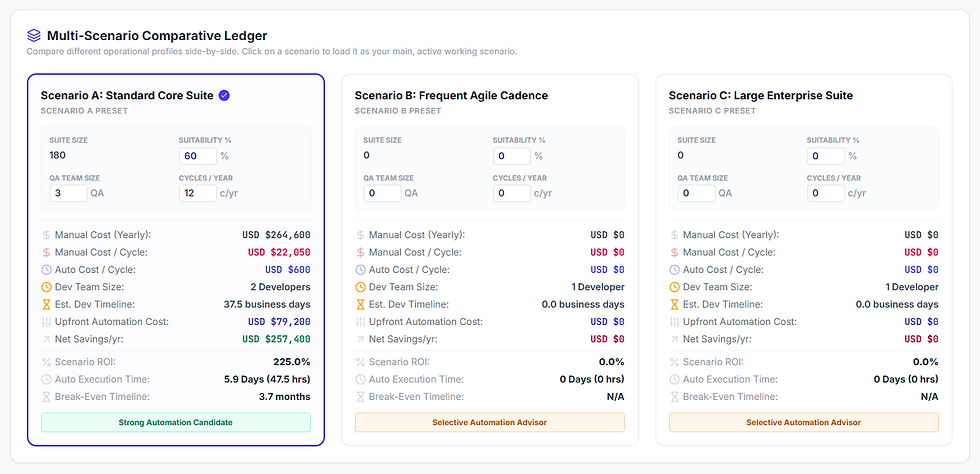
ROI percentage
Annual savings
Payback period
Cost comparison charts
Executive summaries
Visual dashboards help communicate complex information quickly and improve decision-making.


Show the Long-Term Business Value
Automation delivers value beyond financial savings.
Additional benefits include:
Improved software quality
Faster software delivery
Better customer experience
Reduced production risk
Greater release confidence
Improved engineering productivity
Consistent testing practices
Better collaboration
These outcomes are often difficult to express in dollars but significantly influence business performance.
Address Management's Concerns
Every investment carries risk.
Be prepared to discuss:
Initial Investment
Explain implementation costs transparently.
Ongoing Maintenance
Demonstrate how maintainable framework architecture reduces long-term effort.
Team Capability
Show how training and standardisation support successful adoption.
Implementation Risk
Recommend phased implementation rather than attempting to automate everything immediately.
Present an Executive Summary
Many executives prefer a concise summary over technical reports.
An effective executive summary should include:
Estimated implementation cost
Annual savings
ROI
Payback period
Key business benefits
Investment recommendation


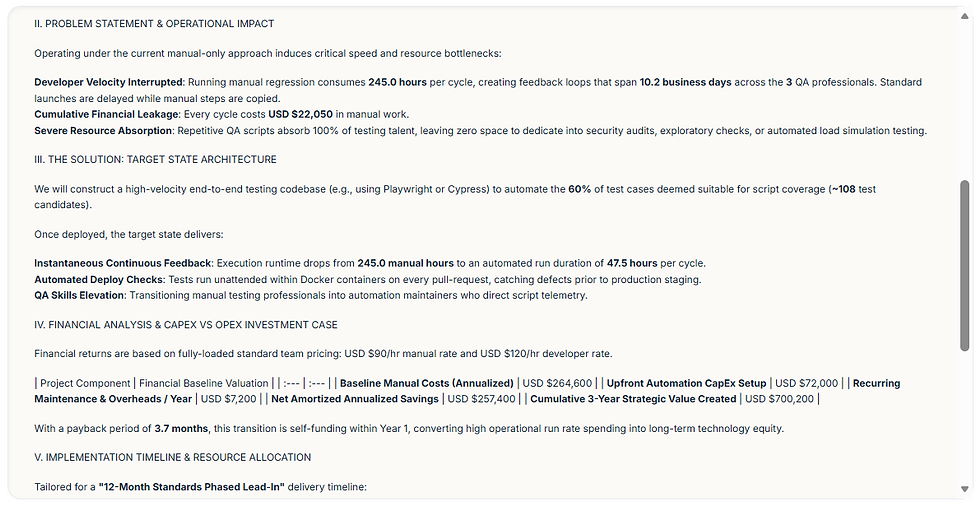

This enables decision-makers to review the business case quickly while still having access to supporting analysis.
Use Data Instead of Assumptions
Successful investment proposals rely on evidence rather than estimates alone.
Whenever possible, include:
Historical testing effort
Release frequency
Regression duration
Defect metrics
Team productivity
Delivery metrics
The more objective the information, the stronger the proposal becomes.


Common Mistakes When Justifying Automation
Many proposals fail because they:
Focus only on technology
Ignore financial impact
Overestimate benefits
Underestimate maintenance
Lack measurable outcomes
Provide no ROI analysis
Present too much technical detail
A balanced business case considers both costs and long-term value.
How OQVERIN Helps
Building a business case manually often involves spreadsheets, assumptions, and significant preparation.
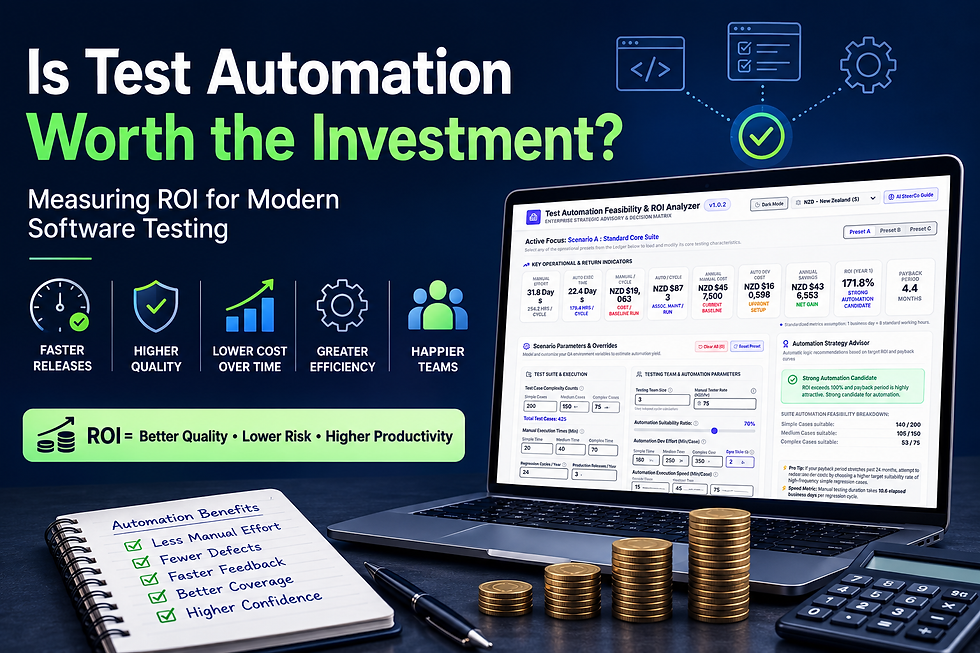
The OQVERIN ROI Analyzer helps Quality Engineering teams estimate automation investment using project-specific inputs.
Depending on the information provided, the ROI Analyzer can generate:
ROI calculations
Annual savings estimates
Payback period
Cost comparisons
Executive summaries
Interactive charts
These insights help engineering teams communicate automation value more effectively and support informed investment decisions.
Final Thoughts
Securing approval for test automation is rarely about choosing the right tool.
It is about demonstrating business value.
Organisations that present automation using measurable outcomes, financial analysis, and executive-friendly reporting are far more likely to secure investment than those focusing solely on technical capabilities.
By combining Quality Engineering expertise with objective ROI analysis, engineering teams can have more productive conversations with management and build stronger business cases for automation.
Key Takeaways
Build a business case around business outcomes, not technology.
Measure current testing effort before proposing automation.
Include ROI, cost savings, and payback period.
Present information visually using charts and executive summaries.
Address implementation costs and long-term maintenance.
Support proposals with project-specific data.
Use objective analysis to help management make informed investment decisions.


Comments